

Table of Contents
Multicollab is a WordPress plugin that brings real-time and asynchronous document collaboration into the Gutenberg editor, with inline comments, suggestion mode, and approval workflows.
Key Takeaways
- Focus on true collaboration, not just communication. It is about working together toward clear goals, not only exchanging messages.
- Use the right mix of real-time and flexible (async) collaboration so teams can give feedback instantly or at their own pace, depending on the task.
- Keep tools simple and centralized to avoid version chaos, extra costs, and security risks. One platform for editing, commenting, and permissions is easier and safer.
- Use templates to save time. They keep content consistent, on-brand, and speed up drafting and review.
- Set clear collaboration guidelines and update them often to prevent confusion and keep the workflow efficient.
Online document collaboration is essential for content teams, helping them work together smoothly to produce successful content. But the process can be difficult, with a few recurring challenges:
- Misunderstandings and miscommunication from a lack of clarity.
- Managing multiple versions of the same document, especially during review.
- Security risks, since you may have to give external teams broad access to your organizational data.
This article covers five best practices for efficient and secure online document collaboration that help you navigate these challenges.
1. Understand the difference between collaboration and communication
Communication can be as simple as sending an email or a message. Collaboration requires more than exchanging information. It means actively engaging with others to achieve a common goal, sharing ideas, feedback, and insights.
To collaborate well online, content teams should focus on the outcome rather than the activity itself. A practical way to do this is to set tangible goals for each step of content production. For example, “generating topic ideas and descriptions” could be the goal for the ideation phase. Clear goals make every content piece purposeful and valuable.
The challenge here is defining your brand’s goals tangibly in terms of documents. You can tackle this by identifying and monitoring metrics that tell you whether each goal is being met.
2. Collaborate through the right medium
Using the right medium across the phases of content production keeps you efficient while maintaining quality. Document collaboration mediums fall broadly into synchronous and asynchronous.
Synchronous mediums let you collaborate in real time, for example team messaging, video conferencing, and real-time co-editing. This is best when you need quick help or instant feedback.
Asynchronous mediums let you work with teammates on your own schedule, at different times. For instance, if a teammate emails feedback that a section needs rewriting, you can prioritize it when it suits your schedule. This medium suits distributed, cross-functional teams.
Work with your team to decide which medium fits each objective. Many teams prefer synchronous collaboration during ideation and asynchronous collaboration during the editorial phase.
3. Only adopt the tools you need
Juggling multiple tools, third-party editors like Google Docs, separate messaging apps, and project management tools, is frustrating for WordPress teams and can hurt content quality.
Tools like Google Docs are not blog editors, so exchanging feedback on documents with multimedia content like CTA boxes and image carousels often requires slow workarounds like video calls. Multiple tools also create multiple access points to your documents, making internal files more vulnerable to theft or corruption. And maintaining several tools eats into your budget, a real concern for small teams.
You need a document collaboration tool with all the features to produce quality content while keeping your stack lean and costs low.
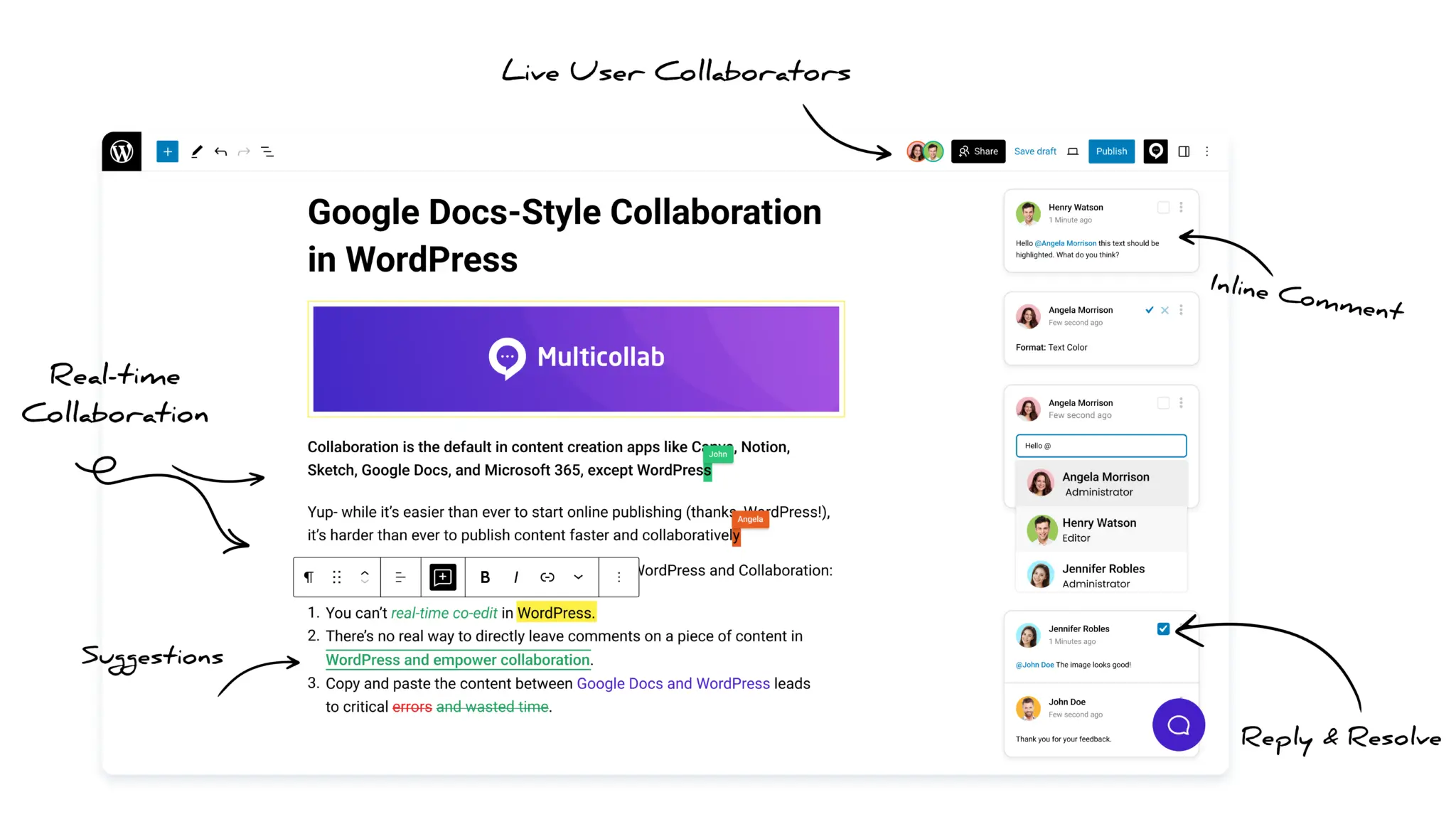
Multicollab is a WordPress collaboration plugin that brings Google Docs-style document collaboration into the Gutenberg editor, supporting both real-time co-editing and asynchronous feedback. You can comment, suggest edits, and tag teammates without leaving WordPress.
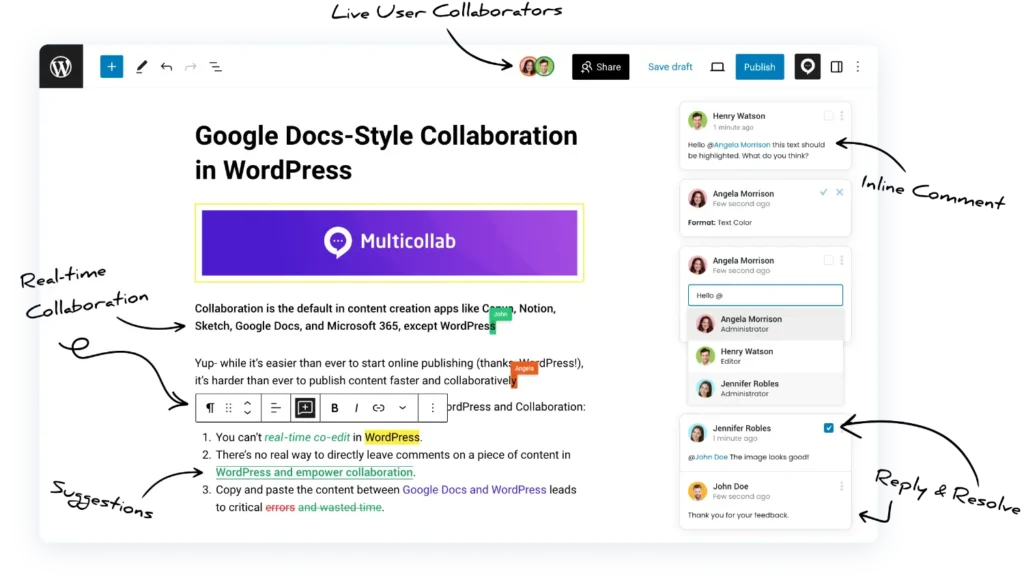
This reduces your dependency on third-party editors like Google Docs and makes your content workflow [VERIFY: about 42% faster] because:
- You can exchange feedback on all kinds of content, including videos, CTA blocks, and image carousels.
- There is no more back-and-forth moving content between a text editor and the blog editor during review.
Multicollab also keeps your data secure, with fewer access points and no need to give external teams broad access to your drives while collecting feedback. You can manage internal and external team permissions in a few clicks. Its collaboration features include:
- Inline comments and @mentions on any block.
- Suggestion Mode with tracked changes that editors accept or reject in bulk (Pro plan).
- Real-time co-editing for up to five people in the same post (Pro plan).
- Content Workflows and an Editorial Checklist to move content through review and enforce standards (Pro plan).
- Guest collaboration for external reviewers without a WordPress account.
For more, see our guides on real-time document collaboration and secure collaboration.
4. Use document templates for faster drafting and review
Document templates help your team ensure published content is in the right format, addresses the right topics, and speaks in your brand voice. Collaborate with your team to create a template for each type of content you produce, and use them as references during drafting and editing.
In the Gutenberg editor, you can create drafts to use as templates or build custom reusable blocks. Because it is a blog editor, your reusable blocks can contain images, GIFs, videos, and even dynamic content, which a plain text editor cannot.
5. Establish clear guidelines and keep updating them
Collaboration guidelines give your team a framework that minimizes misunderstandings, reduces conflict, keeps everyone aligned, and maintains productivity. Create guidelines for the different aspects of content production, including deliverables and communication.
Monitor metrics like “time taken to complete review” and “average time spent per review cycle” to learn whether your guidelines need updating.
Conclusion
Online document collaboration helps WordPress content teams work together efficiently to produce content that serves their audience and meets business goals. Follow these five best practices to collaborate well:
- Help your team understand the difference between communication and collaboration, with more emphasis on collaboration.
- Choose the right medium: synchronous (messaging, video calls, real-time co-editing) or asynchronous (email, comments).
- Adopt a tool like Multicollab to handle both real-time and asynchronous collaboration in the Gutenberg editor, keeping your stack lean and your data secure.
- Create and use document templates in WordPress to make each phase of content development more efficient.
- Set clear guidelines for your processes and update them over time as needed.
If you want to get more out of the WordPress editor and collaborate on documents more efficiently, get started with Multicollab.
Frequently Asked Questions
What is online document collaboration?
Online document collaboration is the process of multiple people working together on a document through a shared platform or software, where they can edit, comment, and give feedback in one place.
Is Google Docs an online collaboration tool?
Yes, but it is inefficient for WordPress content teams. They have to move content from Google Docs into the blog editor before publishing, give external teams broad access to their drives during review, and rely on email or video calls to review videos and dynamic content.
What is the best document collaboration tool for WordPress?
Multicollab is the best fit for WordPress teams. It brings Google Docs-style editorial commenting, suggestion mode, and real-time co-editing into the Gutenberg editor, where you can exchange feedback on all types of content, including multimedia.
What is the difference between synchronous and asynchronous collaboration?
Synchronous collaboration happens in real time, such as video calls or real-time co-editing, and suits quick feedback and ideation. Asynchronous collaboration happens on each person’s own schedule, such as comments or email, and suits distributed teams and the editorial phase.
How does online document collaboration keep data secure?
Using a single, centralized tool reduces the number of access points to your documents. With a WordPress-based tool like Multicollab, feedback stays inside your own site, so you do not need to give external teams broad access to your organizational drives.
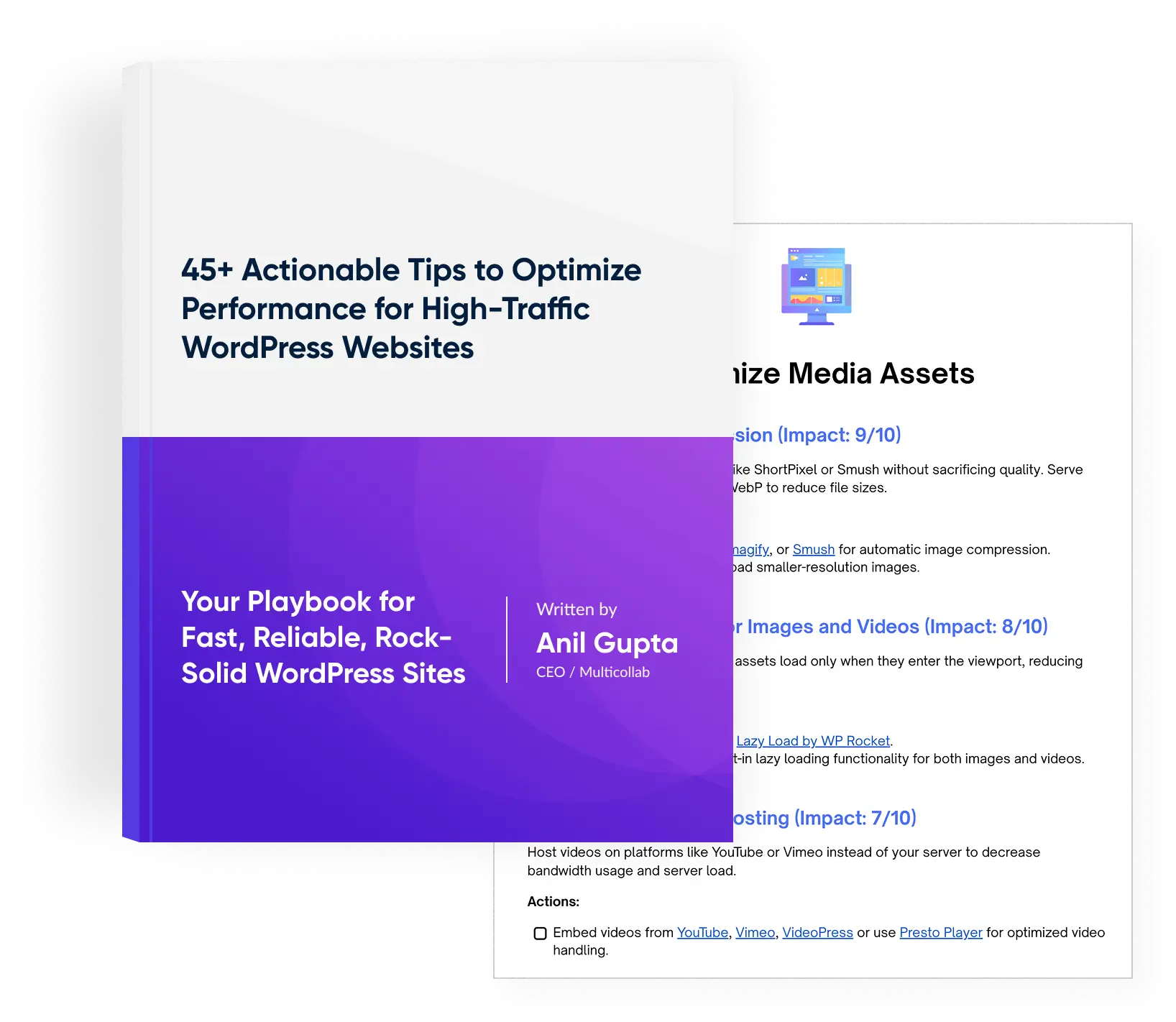
Download a Free Actionable Guide: 45+ Actionable Tips to Optimize Performance for High-Traffic WordPress Websites
Performance Optimization Techniques: Speed up your site with caching, image compression, and code minification.
Hosting and Scalability Suggestions: Learn to choose the right hosting solutions and scale efficiently.
Security and Protection Guidelines: Safeguard your site from DDoS attacks, malware, and performance threats.
Content and Plugin Management Tips: Optimize your database, plugins, and themes for peak performance.