

Table of Contents
Key Takeaways
- Direct collaboration inside WordPress means working on content inside the editor where publishing happens, not in external tools that create version conflicts and formatting loss
- WordPress lacks inline comments, suggestion-based editing, and real-time collaboration by default, forcing teams to move editorial work into external tools like Google Docs
- Effective direct collaboration requires five capabilities working together: real-time editing, inline comments, suggestion mode, structured workflows, and custom permissions
- When collaboration happens inside WordPress, review cycles shorten, version confusion disappears, and formatting remains intact because content never leaves the publishing system
- Native collaboration tools like Multicollab add these capabilities directly into the WordPress editor, eliminating the need for external review tools and maintaining a single source of truth throughout the content lifecycle
WordPress team editing problems arise because collaboration happens outside the editor. The platform lacking the feedback and review capabilities required for editorial work creates version conflicts, formatting issues, and slower publishing cycles.
Direct collaboration inside WordPress means writers, editors, and reviewers work on the same content inside the WordPress editor, where publishing happens. This approach eliminates tool-switching and maintains a single authoritative version throughout the content lifecycle.
What direct collaboration inside WordPress means
Direct collaboration describes the process of creating, reviewing, and refining content through coordinated work that happens entirely within the WordPress editor.
This is distinct from how most WordPress teams work today. The typical workflow moves drafting and feedback into external tools like Google Docs, using WordPress only as the final publishing step.
Direct collaboration removes this separation. Writers draft in WordPress. Editors review in WordPress. Approvals happen in WordPress. Publishing remains in WordPress.
The content never leaves the system where it will be published.
Why most teams do not collaborate inside WordPress
WordPress was designed to manage content publishing, not editorial collaboration.
Until December 2025, the platform lacked inline commenting. WordPress 6.9 introduced Notes, which allow editors to attach feedback to specific blocks. This is a significant step forward, but Notes address only one aspect of editorial collaboration.

Teams still face limitations in other areas:
No suggestion-based editing. When reviewers modify content, they overwrite the draft directly. This removes visibility into what changed, who changed it, and whether the writer agreed with the modification.
WordPress lacks a suggestion mode where proposed changes remain separate from final content.
No real-time collaboration by default. Multiple team members cannot work on the same post simultaneously without version conflicts. WordPress still uses post locking, which blocks other users when someone is editing.
Limited workflow structure. WordPress provides no native way to define review stages, set approval requirements, or enforce editorial gates. Teams must manage these processes manually or through external systems.
No granular permissions for collaboration. WordPress roles control publishing access, but do not provide the fine-grained permissions needed for editorial workflows, such as who can suggest changes versus who can approve them.
Version history exists, but it functions as an audit log, not a collaboration tool. Teams cannot propose changes, see suggestions before they are applied, or review modifications without accepting them.
Because these collaboration capabilities remain incomplete in core WordPress, many teams continue using external tools. Drafts are written or copied into Google Docs, reviewed there, then copied back into WordPress for publishing.
This external workflow creates predictable failures:
- Feedback becomes detached from content. Comments tied to specific paragraphs in Google Docs lose context when content moves to WordPress.
- Multiple versions exist simultaneously. The Google Doc version, the WordPress draft, and any in-progress edits create confusion about which version is current.
- Formatting breaks during transfer. Block-specific formatting, embedded media, and custom layouts degrade or disappear when content moves between tools.
- Review cycles slow down. Clarification loops increase because feedback requires re-contextualization after each tool switch.
The capabilities required for direct WordPress collaboration
To collaborate directly inside WordPress, five capabilities must exist together.
Inline comments. Editors must attach feedback to specific blocks, paragraphs, or sentences. This connects comments directly to the content being reviewed and eliminates ambiguity. WordPress 6.9 introduced Notes, which provide this capability for block-level commenting.
Suggestion-based editing. Reviewers need to propose changes without overwriting drafts. Writers should see what is suggested versus what is final, and accept or reject suggestions individually. This capability is not yet available in core WordPress but is planned for future releases.
Real-time collaboration. Multiple team members must be able to work on the same post simultaneously without creating version conflicts. This prevents duplicate edits and maintains alignment across distributed teams. As of January 2026, real-time collaboration is available exclusively through WordPress VIP’s enterprise platform and is planned for inclusion in WordPress 7.0 (expected in 2026).
Structured editorial workflows. Teams need defined review stages with clear permissions and approval gates. This replaces ad hoc approvals with predictable review steps. Core WordPress does not provide native workflow management.
Visibility and permissions. Custom permissions control who can comment, suggest, edit, or approve. Activity tracking and reports provide visibility into review progress and collaboration activity. These capabilities require plugins or external tools.
Without these capabilities working together, collaboration remains external or incomplete. With them, WordPress becomes a functional workspace for editorial teams.
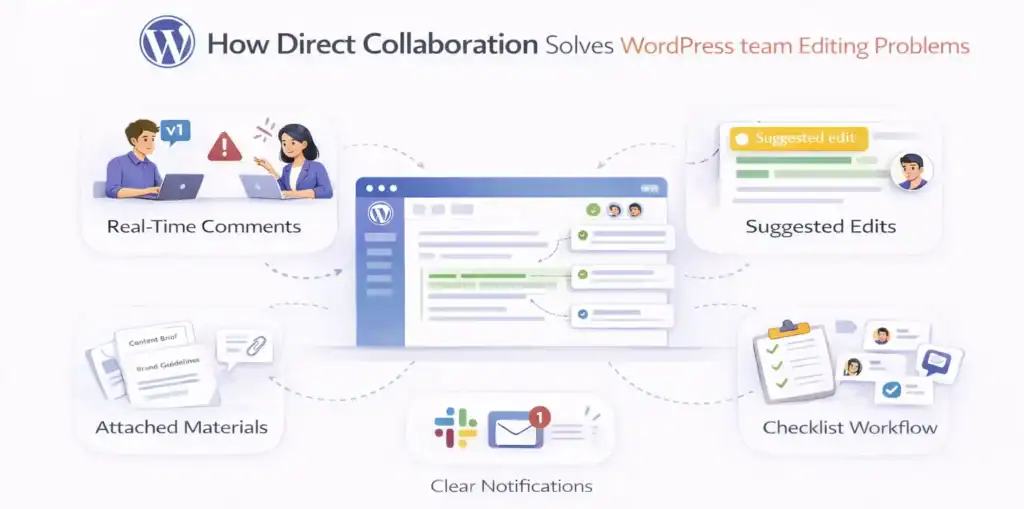
How direct collaboration solves WordPress team editing problems
When collaboration happens inside WordPress, the workflow structure changes.
- Writers draft content directly in the WordPress editor. Editors and reviewers join the same post in real time, seeing each other’s activity as it happens.
- Inline comments provide precise feedback tied to specific content. Reviewers do not need to explain where a comment applies because the comment is attached to the exact location.
- Suggestions appear as proposed changes rather than forced edits. Writers see what reviewers recommend, respond with questions or clarifications, and accept or reject changes individually.
- Editorial checklists guide reviews before approval. Teams define required checks, assign responsibilities, and track completion without external project management tools.
- Notifications keep participants informed through email or Slack. Discussions remain visible and actionable without requiring teams to chase messages across platforms.
- Supporting materials such as content briefs, brand guidelines, or reference documents attach directly to comments. Context stays connected to feedback.
There is no need to move drafts between tools. There is no confusion about which version is current. Formatting remains intact because content never leaves WordPress.
Who benefits from direct collaboration in WordPress
Direct collaboration inside WordPress is designed for teams where multiple people touch content before publishing.
This includes:
- Editorial teams with dedicated writers, editors, and managing editors who review content in stages.
- Agencies coordinating feedback between internal writers, editors, and external clients or stakeholders.
- Publishers producing long-form or multi-author content that requires structured review before publication.
- Distributed teams collaborating across time zones where asynchronous review is more practical than real-time coordination.
- Marketing teams managing approval workflows for brand-sensitive content that requires legal, compliance, or executive sign-off.
The model is not specific to company size, content volume, or industry. It applies wherever structured editorial review is part of the publishing process.
How Multicollab helps address WordPress team editing problems
Multicollab adds the collaboration capabilities described above directly into the WordPress editor.
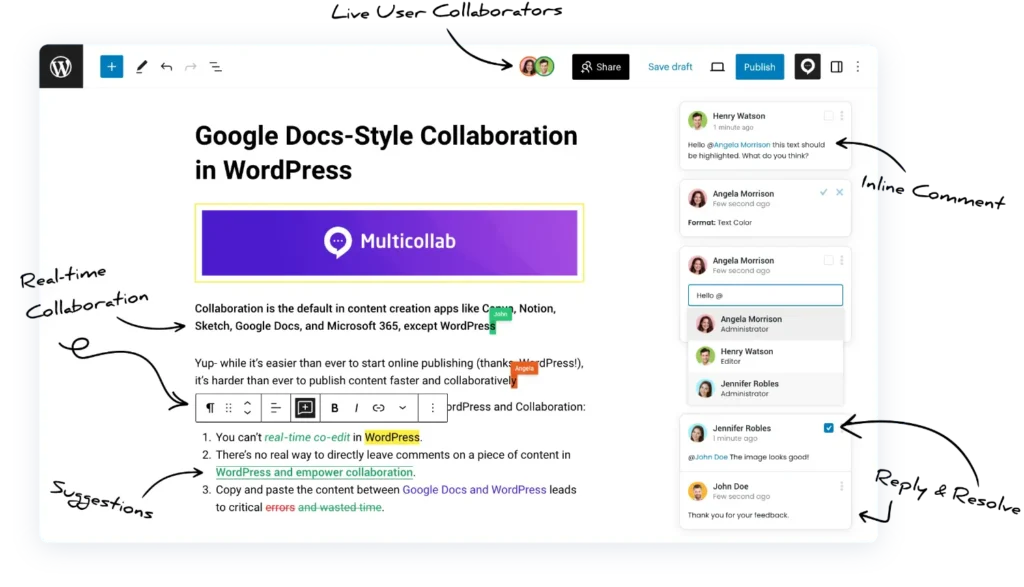
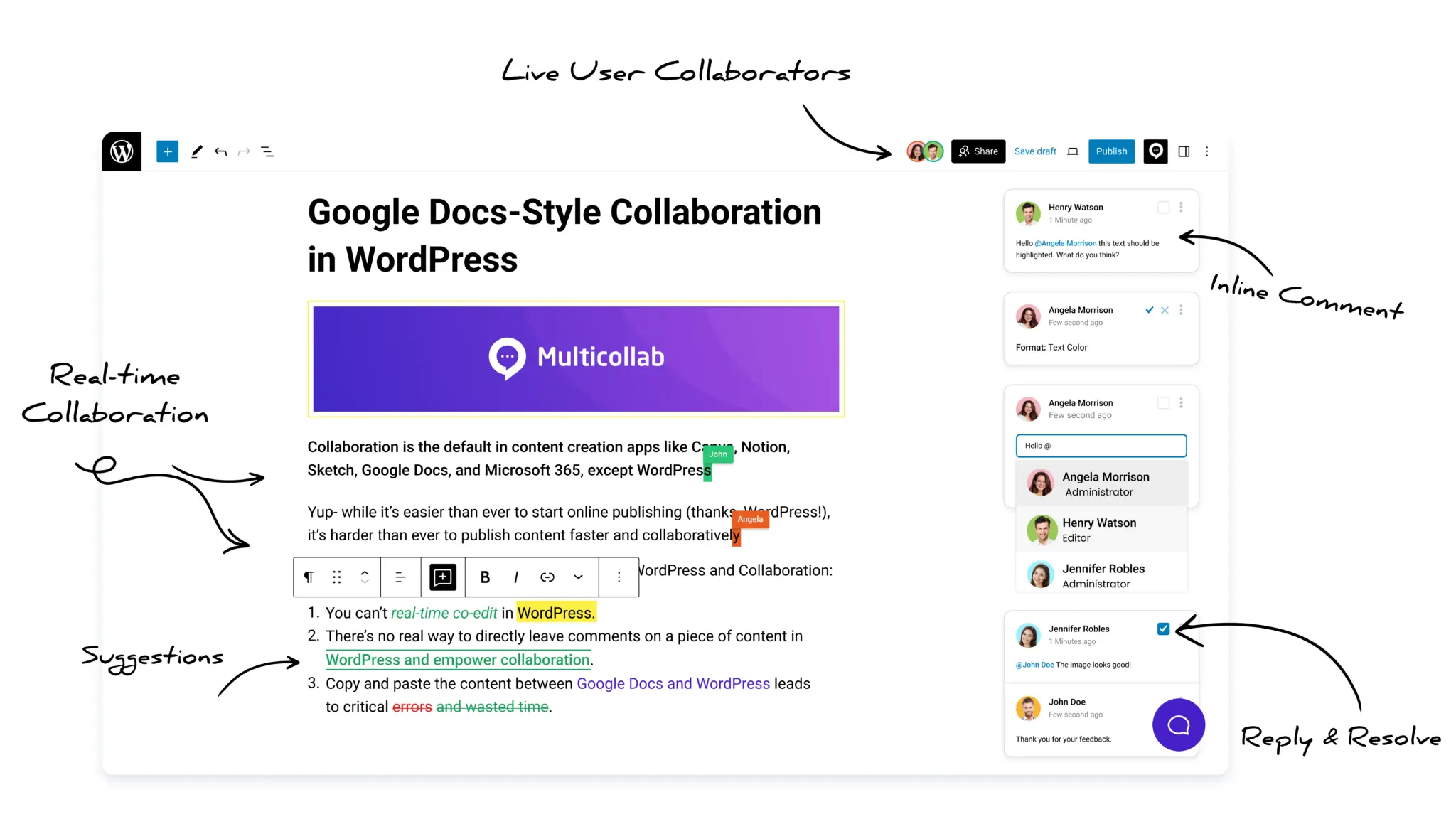
- Real-time collaboration allows multiple users to work on the same post without version conflicts. Participants see each other’s cursors, edits, and comments as they happen.
- Inline comments keep feedback tied to specific blocks or text selections. Comment threads maintain context and allow back-and-forth discussion without leaving the editor. The attach document feature allows collaborators to include images, screenshots, screencasts, or reference files directly in comments.
- Suggestion mode and Create Version enable reviewers to propose changes without overwriting drafts. Writers see suggested edits highlighted, review them individually, and accept or reject each suggestion. Bulk suggestion management allows accepting or rejecting all suggestions at once when appropriate.

- Content Workflows provide structured review stages with defined permissions and approval gates. Teams set up custom workflows that enforce editorial process without manual coordination.
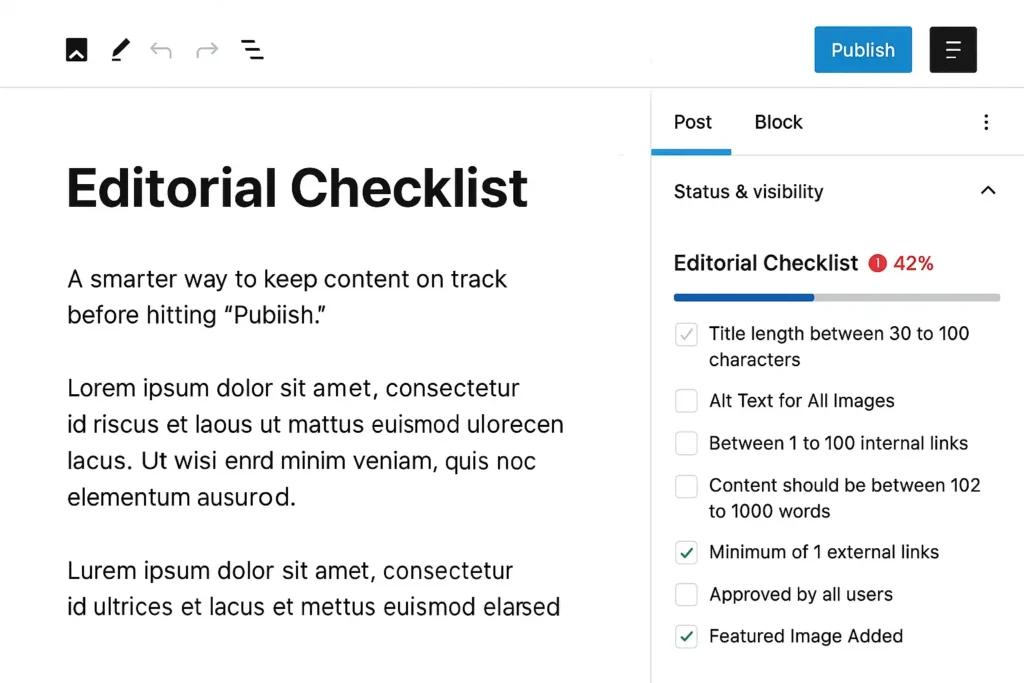
- Editorial checklists ensure required review steps are completed before content moves to the next stage or gets published. Custom checklist items can be assigned to specific user roles with progress tracking.
- Custom permissions control who can comment, suggest, edit, or approve at each workflow stage. This prevents unauthorized changes and maintains editorial control.
- Guest collaboration allows external reviewers such as clients or subject matter experts to comment securely without WordPress accounts. Unique comment links provide direct access to specific feedback.
- Email and Slack notifications keep discussions visible. Activity dashboards and reports provide oversight into collaboration patterns and review bottlenecks.
- The modular features panel allows teams to activate only the capabilities they need. Teams that use suggestion mode but not real-time editing can disable unused features to keep the interface focused.
- It provides multilingual support in six languages for international teams.
Because these capabilities exist inside WordPress, teams no longer need external documents to manage reviews. Collaboration stays connected to the content throughout drafting, review, and approval.
Multicollab functions as a native collaboration layer rather than a separate workflow tool. So, try Multicollab today.
Download a Free Actionable Guide: 45+ Actionable Tips to Optimize Performance for High-Traffic WordPress Websites
Performance Optimization Techniques: Speed up your site with caching, image compression, and code minification.
Hosting and Scalability Suggestions: Learn to choose the right hosting solutions and scale efficiently.
Security and Protection Guidelines: Safeguard your site from DDoS attacks, malware, and performance threats.
Content and Plugin Management Tips: Optimize your database, plugins, and themes for peak performance.